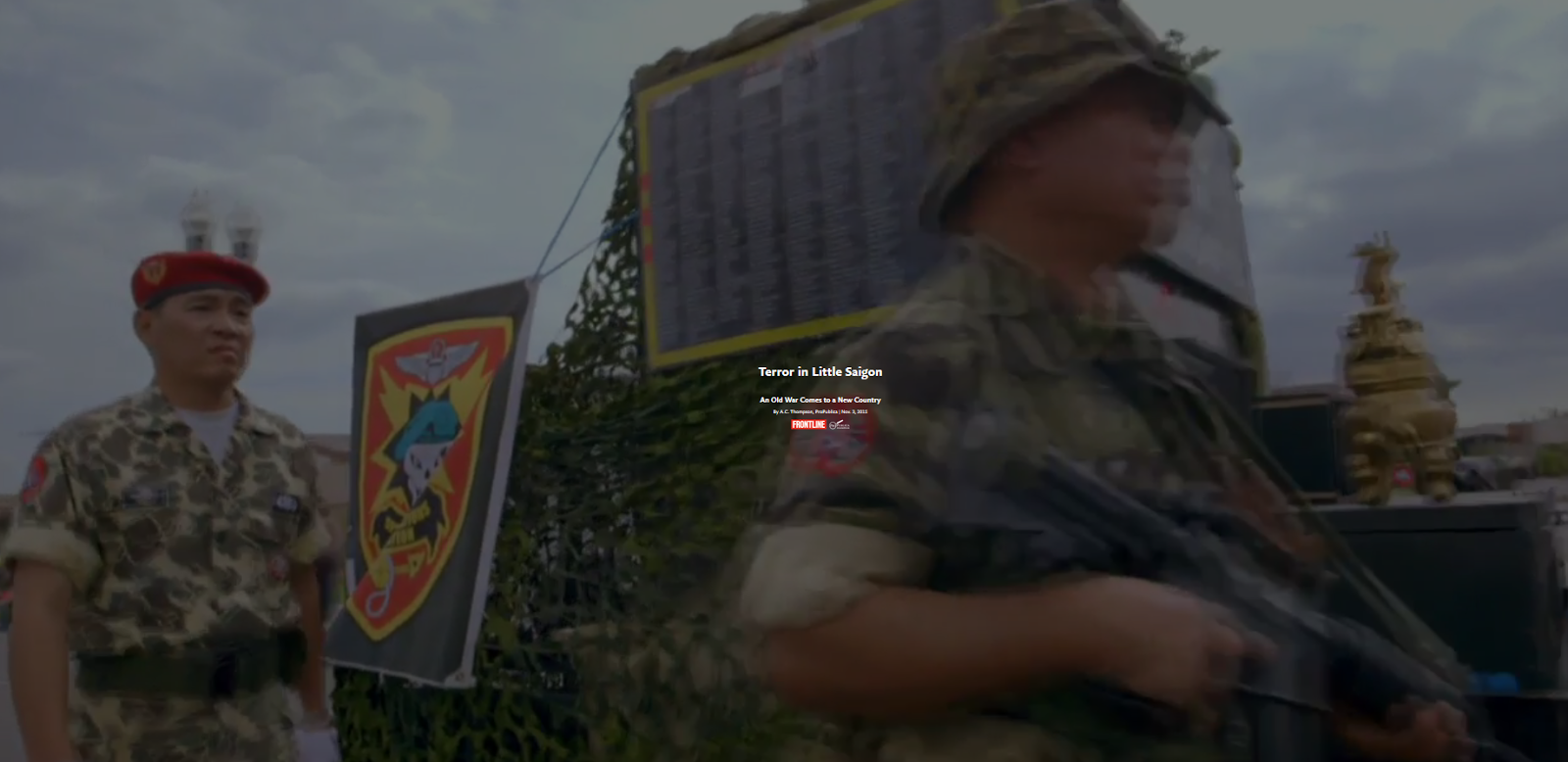
Ý kiến của ông Bằng Phong Đặng văn Âu về Phim "Terror in Little Saigon"sau khi đọc bài viết của Bùi M. Hùng.
Thưa anh Bùi M. Hùng,
Có
những nhà báo Việt Nam viết bài chỉ trích, cáo giác Mặt Trận Quốc Gia
Thống Nhất Giải Phóng Việt Nam (Mặt Trận) là Kháng Chiến Bịp, lừa đảo
đồng bào
để làm tiền bỏ túi, đều bị giết chết. Thủ phạm không bị cơ quan FBI
khám phá, không khí sợ hãi lúc bấy giờ rất ngột ngạt. Mọi người nghi ngờ
sự khủng bố ấy là do bàn tay của Mặt Trận, nhưng không ai dám nói ra.
Có
đoàn viên Mặt Trận đổ tội sự thanh toán tàn bạo dã man kia là do bàn
tay của Việt Cộng đứng trong bóng tối lợi dụng để đồng bào nghi ngờ Mặt
Trận nhúng
tay vào tội ác. Đó là một lập luận của người mắc bệnh "down syndrome"
(bệnh phương trệ tinh thần) vì tính ấu trĩ.
Theo
tôi, đứng trước những cái chết của 5 nhà báo viết bài tố giác, Mặt Trận
đáng ra phải công khai mạnh mẽ lên án hành vi dã man của kẻ sát nhân và
phải
treo giải thường bằng số tiền mặt thật lớn cho người nào tìm ra thủ
phạm để chứng tỏ mình không phải là thủ phạm. Trái lại, Mặt Trận đã im
lặng thì sự nghi ngờ của quần chúng càng tăng cao. Ai trồng khoai đất
này?!
Đáng
lý ra những nhà báo có tình liên đới nghề nghiệp cũng phải lên án bọn
sát nhân và phải làm đơn yêu cầu giới hữu trách Hoa Kỳ tìm cho ra thủ
phạm.
Nhưng nhà báo tị nạn đã im lặng vì sợ hãi liên hệ bản thân. Tôi đánh
giá họ quá tầm thường, vì không có lương tâm chức nghiệp. Một hình thức
nào đó là đồng lõa với tội ác.
Nhận định về việc Đài Truyền hình PBS sẽ chiếu cuộc điều tra về vụ khủng bố ở Little Saigon của hai nhà báo Mỹ, anh Bùi M. Hùng viết:
" (Theo tôi) đây là thêm một đòn thù, của những kẻ không ưa Cộng Đồng Người Việt Quốc Gia.." là không đúng.
Lương
tâm của nhà báo là phải đi tìm sự thật để đưa kẻ sát nhân ra ánh sáng;
chứ không phải một đòn thù nhắm vào Cộng Đồng Việt Nam.
Họ
vẫn đăng thư của Chiến hữu Chủ tịch HCM trên tờ báo Kháng Chiến từ quốc
nội gửi về thăm đồng bào quốc ngoại vào dịp Tết Nguyên Đán và các cháu
nhi đồng
vào dịp Tết Trung Thu trong nhiều năm. Họ cũng đăng những tin tức Mặt
Trận triệt hạ nhiều đồn Công An Cộng Sản mà nếu tổng kết số đồn Công An
Cộng Sản bị Mặt Trận hạ thì "Quân Ta" đã tiến gần Saigon rồi! Những cái
lon dán CỜ VÀNG BA SỌC ĐỎ để kêu gọi đồng
bào yểm trợ kháng chiến đặt khắp các chợ VN, nhà hàng ăn VN trên toàn
nước Mỹ. Những em bé ngây thơ ở vào tuổi "teen" mặc đồng phục áo nâu,
quần kaki mang báo Kháng Chiến đi bán, nhiều người VN biết Kháng Chiến bịp bợm mà vẫn phải mua để tránh bị quấy
nhiễu!
Cho đến khi Cộng sản mở cửa, sự đi lại của nhiều người Việt Nam từ trong nước ra và nhiều người Việt tị nạn về nước, Mặt Trận mới chấm dứt phao
tin láo để đánh lừa đồng bào. Nhiều lần tôi đòi hỏi Mặt Trận (cha đẻ Đảng Việt Tân) ai là người giả danh Phó Đề đốc Hoàng Cơ Minh viết thư thăm đồng bào, họ đều im lặng. Cho nên, dù Việt Tân có nhiều thủ đoạn ma mảnh đến mấy
thì đồng bào cũng không tin tưởng vì Việt Tân không dám trả lời SỰ THẬT!
Sự
lừa đảo trắng trợn đã lộ diện, lẽ ra Mặt Trận phải cuốn gói mà đi cho
khuất mắt. Những người thiện tâm trót đóng tiền cho Kháng Chiến bịp, đều
chấp
nhận "thí cô hồn". Những người hăng hái Chống Cộng trót tham gia Mặt
Trận chắc chắn đau lắm, vì trót trao duyên nhầm tướng cướp.
Cái tài của Mặt Trận là không biết xấu hổ, lại đẻ ra Đảng Việt Tân, cho nên chính sự trong cộng đồng mới nhiễu nhương, phiền hà.
Tôi
thách thức Việt Tân dám cho biết ai là người giả danh Phó Đề Đốc Hoàng
Cơ Minh đã chết còn có thể viết thư từ quốc nội gửi ra hải ngoại.
Ai
là người phịa những thông tin Kháng Chiến Quân đánh sập và tiêu diệt
đồn Công An Cộng Sản trên TV, trên Đài Phát Thanh, trên Báo chí. Có phải
người đó là chiến lược gia Nguyễn Xuân Nghĩa không?
Cái
tồi bại của báo chí Chống Cộng ở hải ngoại đều biết Phó Đề đốc HCM đã
chết qua thông tin của báo Thái Lan, là im lặng trước sự dối trá của Mặt
Trận. Tôi
cho đó là sự hèn hạ của nền báo chí Việt Nam Tỵ Nạn ở xứ sở Tự Do. Họ cam tâm đồng lõa với sự bịp bợm, dối trá của Mặt Trận. Cho nên, các nhà báo, bình luận nổi tiếng như mấy ông Tiến sĩ có viết hàng triệu bài viết chống Cộng thì kẻ thù chẳng xem
có giá trị gì cả.
Tôi
đã viết nhiều bài báo tỏ ra khinh bỉ cộng sản vì chúng không biết xấu
hổ. Vậy người Chống Cộng phải biết xấu hổ mới làm cho kẻ thù kính nể
được. Nếu
tất cả đều thi đua không biết xấu hổ thì QUỐC - CỘNG chống nhau là để tranh miếng cơm thôi, chứ chẳng phải vì lý tưởng tự do, dân chủ gì cả!
Tôi
hoan nghênh và biết ơn những nhà báo Hoa Kỳ bỏ công đì tìm SỰ THẬT để
trả lại CÔNG LÝ cho những nhà báo tố cáo sự lừa đảo mà bị giết.
Lẽ
ra nhà báo Việt Nam phải tham gia vào cuộc điều tra để làm sáng tỏ cái
CHÍNH NGHĨA vì sao ta đến đất nước này. Có phải vì khao khát tự do hay
vì giá
áo túi cơm? Hãy trả lời tôi đi, các nhà truyền thông! Việt Tân
viết thư phản đối hai nhà báo đi tìm SỰ THẬT là biểu lộ sự hốt hoảng, sự
sợ hãi việc làm khuất tất của mình bị phơi bày ra ánh sáng. Nếu Việt Tân là cây ngay, thì đâu sợ chết đứng?
Tôi
chống Cộng không mệt mỏi cho đến hơi thở cuối cùng là vì LƯƠNG TRI của
con người có lòng tự trọng và có lòng yêu thương dân tộc mình. Tôi
cương
quyết chống lại sự bịp bợm, dối trá, lừa đảo, lưu manh của bất cứ ai
thì sự Chống Cộng của tôi mới có ý nghĩa, cho dù bản thân bị sát hại.
Sở
dĩ Việt Nam bị cộng sản thống trị cho tới ngày hôm nay, bởi vì người
dân Việt Nam không đủ sáng suốt, dũng cảm để chống lại điều sai trái.
Tôi viết
thư này để khuyên anh Bùi M. Hùng đừng đánh đồng Mặt Trận hay Việt Tân, với cộng đồng Việt Nam tỵ nạn cộng sản. Nếu đánh đồng một duột như thế thì hóa ra CỘNG ĐỒNG VIỆT NAM TỴ NẠN CỘNG SẢN đều là một lũ đi lừa để kiếm cơm cả sao? Phải
sáng suốt kẻo bị bọn xấu lạm dụng danh nghĩa, anh Bùi M. Hùng nhớ cho kỹ nhé.
Thằng Việt Cộng đã lừa chán chê rồi, anh Bùi M. Hùng chưa sáng mắt à? Sao lại để cho cái đảng thoát thai từ Mặt Trận lừa bịp tiếp tục lừa bịp? Làm
người phải có khí phách, có nhận thức điều phải, điều trái, điều đúng,
điều sai mới đáng sống anh Hùng ạ! Phải đặt CÔNG LÝ lên hàng đầu, đừng
để cho tình cảm riêng tư lấn át lý trí!
Thân chào tạm biệt anh,
Bằng Phong Đặng văn Âu
Tái bút: Nếu những nhà báo bị bọn gian sát hại là người Mỹ chính cống (tức là không
phải người Mỹ ăn nhờ ở đậu như chúng ta) thì chắc chắn FBI đã bỏ công và tiền bạc cố tìm cho ra thủ phạm rồi. Sự giết nhau trong cái đám Ghetto Việt Nam chẳng đáng cho họ quan tâm đâu. Nếu tôi là nhà tỉ phú như ông Hoàng Kiều, tôi sẽ bỏ tiền
ra thuê thám tử tư vào cuộc thì chắc chắn thủ phạm sẽ bị đưa ra ánh sáng từ lâu rồi.
------
In
the 80’s, a number of Vietnam journalists were killed for writing
articles criticizing and denouncing The National United Front for the
Liberation of
Vietnam (also called The Front/Mặt Trận) as a concocted Resistance,
scamming the community for money (1). The FBI did not discovered who the
culprits were, and the climate of fear was so stifling at the time.
Many people suspected that terrorism was at the
hands of the Front, but to date no one has dared to speak out. Members
of the Front blamed the savage and brutal assassinations on the
Vietnamese Communists who they claimed were taking cover in the highly
charged anti-communist atmosphere of the time, (conveniently
helped fan a campaign of reclaiming Vietnam passion by the Front) to
redirect the suspicion and lay their blame at the doorstep of the Front.
It is an argument smack of childish imagination and distortion.
In
my opinion, in the face of the murder of five journalists whose
articles denounced them, the Front should have publicly and resolutely
condemned the
barbaric behavior of the murderers and should have announced some large
cash rewards for those who could help bring the perpetrator(s) to
justice, proving the Front was not the culprit. On the contrary, the
Front had kept their silence, which served to sow
doubts on people’s mind. Who else could have carried out such dastardly
acts?!
On
the other hand, the other silent journalists - if they honor their
profession – they should have expressed their solidarity with their
murdered members
by condemning the killers and petitioned the U.S. authorities to find
the perpetrators. But these refugee journalists were silent because they
were afraid of the risk of becoming tangled in the web of murders
themselves.
I
abhor their smallness, because by choosing to remain silent they had
been complicit with evil acts, showing no professional conscience.
Regarding
the PBS Television airing of the investigation into the terrorist
attack in Little Saigon by two American journalists, Bùi M. Hùng wrote,
"(I
think) this is another revenge attack by those who dislike the
nationalist Vietnamese community…” I don’t believe this statement is
correct. The conscience of the journalists is to seek the truth in order
to bring the murderers to light; it is not a vengeful
attack targeting the Vietnamese community. I know Bui Manh Hung is
not a Việt-Tân (Vietnam Reform Party) member, but he fell in line with
the Vietnam Reform Party’s defensive propaganda line. He should remember
that the Front of Rear Admiral
Hoang Co Minh does not represent the Vietnamese nationalist community.
The Front is a phony Resistance organization aiming to make money
illicitly. Because after Rear Admiral Minh died on the Thai-Laos border
and the image of Vice-Admiral Minh lies dead in
a pool of blood was published in Bangkok newspapers, the Front had been
trying continually to deceive people year after year. Bear in mind that
Hoang Co Minh’s return to Vietnam was a celebrated public affair and
surely the Vietnam Communist would be privy
to. He led an army of about several dozens people to fight the
communists who has under their disposal army of divisions strong. There
were no military strongholds in the country, no safe rearguard areas or
bases where Hoàng Cơ Minh and his band of ragtag
army could be inserted and hideout safely to make inroad into Vietnam
to launch their guerrilla activities. Unable to eat his crow, the
Eastward movement led by Hoàng Cơ Minh became but a suicidal mission,
aiming to whitewash his crimes of false pretense;
it is not to be treated as an heroic act such that of Jing Ke’s who
tried to assassinate the Qin emperor. Yet the Front for years had still
tried to conceal information about Hoang Co Minh’s death.
The
Front continued to publish open letters, purportedly from
president-cum-commander Hoang Co Minh, printed on the Front’s Resistance
Newsletter, presumably
sent to America from some secret outpost in the Thai-Lao-Vietnam border
during the Lunar New Years or during the children’s Trung
Thu/Mid-Autumn festivals for many years. They also printed news of the
Front’s victories, destroying many Public Security strongholds,
from the inflated sum of the Front’s numerous claims of defeated
Communist police stations, it would seem ‘our side’ would soon enter
Saigon! Tin cans pasted with the Three Stripe Yellow Flag were placed in
many VN markets and restaurants nationwide. The innocent
"teen" youngsters dressed in brown shirt and khakis pant uniforms
selling the Front’s Resistance newspapers would garner support from many
Vietnamese who know about the Resistance’s bluff and dissimulation, yet
they’d buy to avoid harassment!
Only
when the Communist Vietnam opened its door, and the movement of
Vietnamese in and out of Vietnam began, did the Front terminate their
lies to deceive
the people. Many times, I’d demand the Front (forerunner of the Vietnam
Reform Party) to come clean with who was the person impersonating
Vice-Admiral Hoang Co Minh to write letters greeting the people, they’d
remain silent. So, no matter how great Viet Tan
is with many of its deceits and trickeries, many people would not trust
them because Viet Tan did never dare to reveal the truth!
After
the blatant fraud has been revealed, Viet Tan should have had the
decency to pack up and got out of sight. The good-will people who have
donated
to the fake Resistance have accepted and cut their losses to the "ghost
factory." Perhaps those who have enthusiastically participated deep in
the anti-communist Front are certainly hurt, because they have
mistakenly slept with the enemy. The genius of the
Front is its shameless effrontery, they even gave birth to Viet-Tan
(The Vietnam Reform Party), that is why the community’s political
situation is deteriorating and problematic. The Front even dares to say
people who expose its shady affairs are aiding and
abetting the communist! In truth, the communists - more than anyone
else - are completely aware of the Front’s deceits and lies, because
they have their intelligence and spies. Their Embassies and Consulates
monitored the overseas Vietnamese very closely.
The Vietnamese Communists got the Vietnam Reform’s scams by the balls
so the Vietnam Reform Party can only carry out the Communist biddings!
Saying this is a bit vulgar, but the loud vociferous anti-Communist
Viet-Tan is just like the saying of the old folks:
"The prostitutes is preaching morality!" or “the pot calling the kettle
black!” I dare Viet Tan to divulge the identity of the person who
impersonated Vice-Admiral Minh to write letters and sent them overseas
after his death.Who gave false information
about the Resistance army demolishing police stations and killing
communists on TV, radio, and in the newspapers? Is he not the strategist
Nguyen Xuan Nghia?
What
is so low and distasteful about the overseas anti-Communist press is
that they had learned of Rear-Admiral Hoang Co Minh’s death through the
Thailand
press, yet remained silent in the face of lies and false pretention
from the Front. I regard this as the abject low-down of the Vietnamese
refugee Press in a free nation. They have acquiesced to the bluff, and
become complicit in the Front’s deception. So
famous journalists and commentators - some armed with their Ph.D’s -
even if they could write millions anticommunist articles, their enemy
would not lose a wink of sleep or incur an ounce of worry, theirs is
nothing worth reading. I have written many articles
expressing my scorn for the communists because they do not know shame.
So
anti-communist people must learn to feel shame in order to earn respect
from their enemies. If people from both sides compete to emulate each
other’s
shamelessness then Nationalists and Communists fighting each other just
to compete for some material gain and recognition, but nothing about
the cause of liberty, democracy! No matter who hate and despise me for
speaking the TRUTH, no one can look down on
me, Mr. Hung, sir!
I
welcome and appreciate the American journalists who seek the truth to
return justice to those journalists who’d denounced the fraud that got
them killed.
Vietnam journalists should be involved in investigative journalism to
clarify the justness why we’ve come to this country. Is it because of
the desire for freedom or the desire to line one’s coat pocket? Please
answer me, Vietnamese media!
Viet
Tan writing letter object to the two reporters searching for TRUTH is
actually an expression of their nervousness, their fear of having their
dishonest
acts exposed. If Viet Tan is an upright tree, then they wouldn’t be
afraid of dying standing up straight, would they?
I
will struggle against the communists until my last breath because of
the dictate of my conscience, because of human dignity and because of
love for my
people. I stand resolutely against the bluff, deception, fraud,
dishonesty from any side, for only that would give my anti-Communism new
meaning, even if I myself would get murdered. The reason Vietnam is
still dominated by communists today is due to our people’s
inability to be keenly aware of right and wrong, being brave enough to
fight against injustice.
I am writing to advise you Mr. Bùi M. Hùng
not to equate the Vietnam Reform Party (Việt Tân or The Front) with the
Vietnamese communities
seeking freedom from communist Vietnam. If you equate the Vietnam
overseas communities lock-stock-and-barrel with the Front then it would
seem that the Vietnam political refugees who had been escaping en masse,
their raison d’être in America was to search
for some monetary gain. Why would we let a Party reincarnated from the
Front continue to defraud us?
Human
beings must be courageous, they must be conscientious of what is right,
what is wrong; their existence on earth should be that of a life worth
living,
Mr. Hung! JUSTICE must trump, do not let personal feelings overwhelm
reason!
I bid you good bye,
Bằng Phong - Đặng văn Âu
PS:
If the five murdered journalists were red-blood Caucasian Americans
(i.e. not just Americans seeking refuge and security in America like us)
then surely
the FBI would have poured more money into the investigation, trying
everything in their formidable arsenal to rat out the culprits long time
ago.
The
killing of each other in the crowded Vietnamese Ghetto is not worthy
for them to care. If I were a billionaire like Hoang Kieu, I will spend
money
to hire private detectives then certainly the perpetrators will be
brought to justice already.
Đính kèm bài viết của Bùi M. Hùng
On Mon, Nov 2, 2015 at 9:22 PM, BMH< amsfv@aol.com> wrote:
Thưa Quý Vị, Quý NT và CH...
Sau khi tôi gởi đến Quý Vị bản tin liên quan đến : Phim "Terror in Little Saigon"(Theo tôi) đây là thêm một đòn thù, của những kẻ không ưa Cộng Đồng Người Việt Quốc Gia..
Sau đó tôi đã nhận được copy thơ lên tiếng phản đối từ Việt Tân - HTĐ gởi hai tổ chức thực hiện phim :"Terror In Little Saigon", cùng với bài viết hồi tháng 8 được đăng trên The Rushford Report của Greg Rushford "How Hanoi Buys Influence in Washngton DC" tạm dịch: Hà Nội “mua ảnh hưởng” ở Washington như thế nào?
Xin mời Quý Vị theo dỏi để tường...và tùy nghi thẩm định...** Cám ơn Việt Tân đã nhanh chóng phản ứng và Anh Huỳnh Quốc Huy đã chuyển tài liệu đến tôi..
BMHWashington, D.C--------------Hà Nội 'mua ảnh hưởng' ở Washington thế nào
BBC / 5 tháng 8 2015

Tổng Bí thư Nguyễn Phú Trọng thăm Hoa Kỳ vào tháng 7/2015
Chia sẻ Nhà báo Greg Rushford người Mỹ chuyên viết phóng sự điều tra về chính trị trong mậu dịch quốc tế vào hôm 04/08 có bài đăng trên trang rushfordreport.com của ông có tựa ' How Hanoi Buys Influence in Washington, D.C.' (Hà Nội mua ảnh hưởng ở Washington thế nào).Bài viết mô tả điều được cho là việc Đảng Cộng sản Việt Nam đã "âm thầm mua ảnh hưởng" nhằm thúc đẩy nghị trình ngoại giao của Hà Nội ở Washington và "chiến dịch vận động tinh vi" này dường như đã và đang có kết quả.BBC điểm lại nội dung chính của bài cùng quí vị. Bài viết mở đầu bằng việc đề cập tới chuyến công du tới Việt Nam trong tuần này của Ngoại trưởng Hoa Kỳ John Kerry với nghị trình chính được dự kiến là tăng cường quan hệ kinh tế và an ninh quốc phòng.Chuyến đi diễn ra sau gần đúng một tháng kể từ khi Tổng Bí thư Nguyễn Phú Trọng gặp Tổng thống Obama hồi tháng Bảy.Nhà báo Rushford mô tả về điều mà ông gọi là “chuyện thường gặp” trong chủ đề nhân quyền vốn là cái gai lớn trong quan hệ Mỹ Việt.Tác giả nói ông hy vọng là vào tuần này Bộ Công an Việt Nam sẽ hành xử tốt hơn hồi tháng Năm khi khi cố vấn hàng đầu về nhân quyền của ông Kerry là ông Tom Malinowski thăm Hà Nội.Chỉ sau hai ngày ông Malinowski có các buổi làm việc “hữu ích” với giới chức ở Hà Nội thì blogger Anh Chí (Nguyễn Chí Tuyến), một nhà bất đồng chính kiến, đã bị người ta đánh đổ máu.Sau cuộc gặp với ông Obama ở Washington, ông Nguyễn Phú Trọng có bài diễn văn tại một viện nghiên cứu có ảnh hưởng là Trung tâm Nghiên cứu Quốc tế và Chiến lược (CSIS) nơi ông Trọng nói “Tôi khẳng định Việt Nam hết sức coi trọng vấn đề quyền con người.”“Bảo vệ và tăng cường quyền con người là mục tiêu chính của chính phủ Việt Nam," ông Trọng nói tại CSIS.'Sự cố xấu xí'Thế nhưng chỉ ngay trước khi ông Trọng đọc diễn văn thì đã có một sự cố mà tác giả mô tả là “xấu xí” xảy ra.Sự cố này cho thấy những gì thực sự diễn ra khi giới chức Hoa Kỳ và Việt Nam khen Việt Nam có “tiến bộ nhân quyền rõ rệt”.“Hơn nữa, sự việc đáng hổ thẹn tại CSIS cho ta thấy một chỉ dấu về việc Đảng Cộng sản đã âm thầm mua ảnh hưởng nhằm thúc đẩy nghị trình ngoại giao ở Washington thế nào.“Đây là chiến dịch vận động tinh vi dường như có kết quả”, theo tác giả. “Hà Nội dường như biết được rằng ở Washington, có tiền là được việc (money talks).Sự cố mà tác giả mô tả là giới an ninh Việt Nam tác nghiệp ngay trên đất Mỹ xảy ra khi một công dân Mỹ tới nghe ông Trọng nói tại CSIS đã bị đưa ra ngoài tòa nhà mặc dù có tên trong danh sách khách mời tham dự.

Đã có biểu tình trước Tòa Bạch Ốc khi Tổng thống Obama tiếp Tổng Bí thư Nguyễn Phú Trọng.
Bác sỹ Nguyễn Thể Bình đã từng tham dự nhiều sự kiện tại CSIS đã bị một thành viên cao cấp của CSIS là ông Murray Hiebert, cùng với một nhân viên an ninh của viện nghiên cứu này, yêu cầu rời tòa nhà.Tác giả Rushford cho biết nhân viên an ninh của phía Việt Nam không cho phép bà Bình nghe bài diễn văn của ông Trọng và rằng khi bà đi lên phòng để dự sự kiện này thì được thông báo rằng bà là diện không được tiếp đón (Persona Non Grata)."Ông Hiebert nói với bà Bình rằng ông đã cố gắng giải thích với giới an ninh Việt Nam thì vẫn chẳng có ích gì. Ông Hiebert đã xin lỗi bà Bình và thừa nhận rằng việc CSIS chịu áp lực khiến phải hành động như vậy là sai."Theo tác giả, ông Hiebert, người có thâm niên trong nghề báo và từng làm cho Far Eastern Economic Review và The Wall Street Journal, đã nói thẳng về vi phạm nhân quyền ở Thái Lan và Malaysia khi làm việc tại CSIS.Tại viện nghiên cứu này ông phụ trách nhiều blog viết chỉ trích thực trạng nhân quyền tại Việt Nam mà tác giả là các nhà quan sát có tên tuổi.“Tuy nhiên ông Hiebert dường như đã và đang cẩn trọng không để làm quá mất lòng nhà chức trách tại Hà Nội.“Ông là đồng tác giả của một nghiên cứu năm 2014 đề cập tới các vấn đề nhân quyền tại Việt Nam một cách hơi nương tay, trong khi hoàn toàn không được thẳng thắn về việc chính phủ Việt Nam trả tiền cho điều này,” tác giả nhận định.Nhà báo Rushford cho biết ông đã liên lạc với viện CSIS để cho họ có cơ hội giải thích sự cố xảy ra với bà Bình.“Ông Hiebert từ chối để phỏng vấn mặc dù đồng ý nhận câu hỏi qua email. Tuy nhiên người phụ trách truyền thông của CSIS đã gửi cho tôi email nói rằng ông đã khuyên ông Hiebert cắt đứt liên lạc.“Câu trả lời của ông Hiebert qua email không nói là những gì xảy ra với bà Bình không phải là như vậy và ông đã giảm thiểu sự cố mặc dù nói rằng bà Bình đáng ra phải được phép dự sự kiện này”.Kẻ thù của Nhà nướcTheo tác giả, ngoài thành công về mặt chuyên môn tại một Trung tâm Y khoa Quân đội có tiếng tại Hoa Kỳ, bà Bình bị giới an ninh Việt Nam để mắt tới vì các hoạt động riêng khác.Bà Bình, theo tác giả, làm việc về các chủ đề nhân quyền tại châu Á với một số tổ chức có tiếng như Human Rights Watch và Amnesty International.“Bà ra làm chứng trước Ủy ban Tự do Tôn giáo Quốc tế của Hoa Kỳ và tham gia nhiều buổi điều trần khác.“Và vào ngày 1 tháng Bảy, bà Bình cùng với các nhà hoạt động cho dân chủ và nhân quyền Việt nam được mời vào Tòa Bạch Ốc nơi bà đưa ra các khuyến nghị cho Hội đồng An ninh Quốc gia (NSC) về cách ông Obama bàn thảo chủ đề nhân quyền với Tổng Bí thư Trọng như thế nào vào ngày 07/07 tại Phòng Bầu dục.“Cũng có thể là trong khi hai nhà lãnh đạo đang họp ở Nhà Trắng thì bà Bình có lẽ đã bị giới chức Việt Nam tại Đại lộ Pennsylvania và Công viên Lafayette chụp hình khi bà cùng hàng trăm người Mỹ gốc Việt biểu tình ôn hòa phản đối việc Việt Nam thiếu dân chủ.”Tác giả cho biết ông đã gửi thư tới Đại sứ Việt Nam tại Hoa Kỳ, ông Phạm Quang Vinh, để tìm kiếm một lời xin lỗi về sự cố bà Bình bị đuổi khỏi CSIS nhưng Đại sứ Vinh đã không trả lời.'Không có tù nhân chính trị'

Ông Cù Huy Hà Vũ từng chất vấn Đại sứ Việt Nam tại Hoa Kỳ về nhân quyền tại viện CSIS.
Vào ngày 24/03/2015, Đại sứ Vinh tham gia với tư cách khách mời bàn tròn thảo luận tại CSIS do ông Hiebert chủ tọa. Ông Vinh tỏ ra bất bình khi bị cựu tù nhân lương tâm Cù Huy Hà Vũ hỏi rằng bao giờ Việt Nam ngưng bỏ tù những công dân mà tội của họ chỉ là chỉ trích Đảng Cộng sản.Ông Vinh khó chịu và phản hồi rằng Việt Nam không có tù nhân chính trị và đã tránh nhìn vào mắt ông Vũ.“Khẳng định rằng Việt Nam không có tù nhân chính trị giống như nói rằng ở Pháp không có pho-mát,” tác giả Rushford so sánh.“Trong khi không nằm trong danh sách khách mời tham dự buổi nói chuyện của Tổng Bí thư Trọng tại CSIS, ông Vũ đã được mời tới Tòa Bạch Ốc vào ngày 01/07 nơi ông cùng bà Bình và những người khác trong đó có Angelina Huỳnh và Hoàng Tứ Duy của Việt Tân, đảng phái mà Hà Nội gọi là một tổ chức "khủng bố".“Hãy tưởng tượng xem giới chức tình báo Việt Nam nghĩ gì trong đầu khi họ đọc thấy tin đưa về cuộc gặp ở Tòa Bạch Ốc vào hôm đó”.“Vì sao một nhà nghiên cứu chính trị của CSIS được nể trọng lại tránh các câu hỏi trực tiếp liên quan tới thực trạng nhân quyền Việt Nam? Tác giả hỏi trước khi tự trả lời rằng “sự nghi ngờ phát sinh là có cái gì đó liên quan tới tiền bạc.”“Hà Nội đã và đang chi khoảng 30.000 USD mỗi tháng cho Podesta Group, một công ty chuyên vận động hành lang có quyền lực với những quan hệ với các chính khách Mỹ có tầm ảnh hưởng lớn.Trang web của Podesta Group quảng cáo về khả năng của hãng giúp các khách hàng gây tranh cãi cải thiện uy tín.“Chúng tôi mướn người từ các viện nghiên cứu thuộc phe tả cũng như hữu.“David Adams, người đã và đang làm việc về mảng Việt Nam cho Podesta Group, từng là người phụ trách chính về các chủ đề lập pháp của bà Hillary Clinton khi bà ngồi ghế ngoại trưởng.“Đại sứ Mỹ David Shear lúc đó còn ở Hà Nội. Ông Shear nay là một thứ trưởng quốc phòng và là một trong những nhân vật giúp định hình các chính sách quân sự của Hoa Kỳ ở châu Á, bao gồm cả việc phản hồi ra sao với việc Việt Nam đề nghị Hoa Kỳ bán vũ khí sát thương để Hà Nội muốn răn đe sự hăm dọa của Trung Quốc ở Biển Đông.“Ông Shear, khi còn là đại sứ Hoa Kỳ, thường xuyên nói với cộng động Mỹ gốc Việt rằng trước khi Việt Nam được phép gia nhập TPP thì Hà Nội phải có tiến bộ rõ rệt về nhân quyền. Ông chưa bao giờ giải thích cụ thể khái niệm này có nghĩa là gì.Cả Podesta Group và Đại sứ Vinh, theo tác giả, đều từ chối bình luận về việc Việt Nam đang đẩy mạnh nghị trình ngoại giao.“Nhưng chẳng cần tìm hiểu nhiều cũng thấy rõ là có ba ưu tiên: Hà Nội muốn Hoa Kỳ bỏ cấm bán vũ khí. Việt Nam muốn thuyết phục Tổng thống Obama và Quốc hội Hoa Kỳ rằng Hà Nội đã có dủ tiến bộ rõ rệt về nhân quyền để tham gia TPP và họ đang vận động cho ông Obama tới thăm Việt Nam, hy vọng là cuối năm 2015.‘Có tiền là được việc’

Ông Rushford nói Chính phủ và Quốc Hội Hoa Kỳ đang ngả theo hướng cho phép Việt Nam mua vũ khí sát thương.
Trang web của CSIS liệt kê các nhà tài trợ theo hạng mục chung. Họ tiết lộ rằng chính phủ Việt Nam trả cho CSIS trong khoảng từ 50.000 USD tới 500.000 USD trong năm 2014. Nhưng trang này không cho biết khoản tiền đó để dùng làm gì.Ông Hiebert là đồng tác giả một nghiên cứu năm 2014 của CSIS có tựa “Một Kỷ nguyên Mới trong quan hệ Mỹ-Việt”. Vậy ai có thể đã trả tiền để làm nghiên cứu này?Người đọc nghiên cứu không thể biết được điều đó ở mục lời cảm ơn. “Chúng tôi ghi nhận sự hỗ trợ hào phóng và chu đáo và những góp ý của Đại Sứ quán Việt Nam tại Washington, D.C., Đại sứ quán Hoa Kỳ tại Hà Nội, và Lãnh sự quán Hoa Kỳ tại Thành phố Hồ Chí Minh.” Nhưng cụ thể là ai đã trả tiền?“Ông Hiebert — sau khi tôi hỏi tới hai lần — đã thú nhận rằng chính phủ Việt Nam trả tiền cho nghiên cứu này. Ông nói rằng không có việc chính phủ Hoa Kỳ cấp vốn cho nghiên cứu đó,” tác giả viết.Theo nhà báo Rushford, trong nghiên cứu “Một Kỷ nguyên Mới trong quan hệ Mỹ - Việt”, ông Hiebert đã chỉ trích các nhà đấu tranh dân chủ nhân quyền trong quốc hội Mỹ là nhóm người lúc nào cũng chỉ trích và chẳng hiệu quả.“Ông Hiebert cũng đã chỉ trích nhiều người Mỹ gốc Việt cổ súy cho dân chủ không hiểu được tình hình thực tế của Việt Nam ngày nay.“Thế nhưng khi nói tới thực trạng nhân quyền của Việt Nam thì ông Hiebert dường như lại thủ thế.“Nghiên cứu không đề cập tới việc Hà Nội không tuân thủ Công ước Quốc tề về Quyền Dân sự và Chính trị mà Việt Nam tham gia. Không đề cập tới các điều luật trong bộ luật hình sự của Việt Nam hình sự hóa tự do ngôn luận, tự do hội họp và chỉ trích Đảng Cộng sản.“Thay vì đề nghị rằng Việt Nam có thể giúp cải thiện uy tín bằng việc hiện đại hóa bộ luật hình sự yếu kém, ông Hiebert chỉ đơn thuần khuyến nghị chính phủ Hoa Kỳ và Bộ Công an Việt Nam nên họp bàn thêm.“Ông Hiebert kịch liệt bác bỏ rằng ông nhẹ lời bởi ai đã trả tiền cho nghiên cứu này,” nhà báo Rushford viết.Theo nhà báo Mỹ, "Nghị trình vận động hậu trường của Hà Nội đang có kết quả. Chính phủ và Quốc Hội Hoa Kỳ đang ngả theo hướng cho phép Việt Nam mua vũ khí sát thương.Có ít việc bàn thảo về “tiến bộ rõ rệt” về nhân quyền bao gồm tự do ngôn luận, tự do hội họp và tự do tôn giáo trong các vòng đàm phán TPP và Tổng thống Obama nói ông muốn nhận lời mời tới thăm Hà Nội mặc dù chưa lên lịch thăm khi nào.“Ông Hiebert nói trong email trao đổi với tôi rằng ông đã khuyến nghị rằng khi nào ông Obama bay sang Việt Nam, ông sẽ nói mạnh hơn về nhân quyền.“Một người hoài nghi có thể quan sát những gì mà Trợ lý Ngoại trưởng Tom Malinowski, Ngoại trưởng John Kerry, và rất nhiều các quan chức khác của Mỹ đã từng làm – quá nhiều lần và chẳng thay đổi được bao nhiêu”, tác giả kết luận.Nhà báo Greg Rushford từng viết cho các tạp chí The Wall Street Journal và The Diplomat. Ông đã từng có bài nhận định về quan hệ Việt Mỹ trong chuyến thăm Hoa Kỳ của Chủ tịch Trương Tấn Sang.--------How Hanoi Buys Influence in Washington, D.C.
posted by Greg Rushford on August 4, 2015U.S. Secretary of State John Kerry arrives in Hanoi this Thursday for a two-day visit. Expect much talk of how the United States and Vietnam have been developing closer security and economic ties — and how Vietnam’s praiseworthy “progress” in improving its human-rights record is making this possible. Hopefully, Vietnam’s feared Ministry of Public Security will be on better behavior this week than back in May. Then, Kerry’s top human-rights advisor, Tom Malinowski, held what he characterized as “productive” meetings in Hanoi with senior Vietnamese officials. On May 11, two days after Malinowski’s visit, thugs wielding metal pipes bloodied a courageous Vietnamese political dissident named Anh Chi. Malinowski deplored the incident, while still insisting that Vietnam has been making commendable “progress” on human rights.Kerry’s Aug. 6-8 trip comes on the heels of a successful visit to Washington last month by Nguyen Phu Trong, the general secretary of the Communist Party. Trong had a “productive” meeting with President Barack Obama in the Oval Office on July 7, after which the two leaders issued a joint “vision” statement that said each country recognized the importance of protecting human rights. The next day, Trong made a major speech at an influential U.S. think tank, the Center for Strategic and International Studies (better known by its acronym, CSIS). “Protecting and promoting human rights is the main objective of our development,” Trong declared. “We want to ensure, promote and protect the rights of all people in Vietnam.”Well, maybe not all. Once again, a familiar pattern emerged: Shortly before Trong’s speech before a CSIS audience of mainly well-connected Washington insiders, there was another ugly incident behind the scenes. The incident illustrates what’s really going on when American and Vietnamese officials praise Vietnam’s “demonstrable” human-rights progress. Moreover, the CSIS embarrassment offers a glimpse into how theCommunist Party has been quietly buying influence to advance its foreign policy agenda in Washington — a sophisticated lobby campaign that appears to be working. Hanoi, it appears, has learned that in Washington, money talks.But that’s getting ahead of this story, which begins with Trong’s July 8 historic speech — the first-ever such appearance for a senior Communist Party leader — at CSIS’ gleaming modern headquarters a few blocks from the White House. As the secretary general was preparing to speak about his deep interest in protecting human rights, Vietnamese security officials were quietly demonstrating otherwise, even on American soil. It seems thatHanoi’s intelligence operatives had a file on one of the invited CSIS guests — like Anh Chi, another enemy of the state.Persona Non GrataWhen Dr. Binh T. Nguyen, a prominent Vietnamese-born physician (and an American citizen) showed up to hear the secretary general’s speech, she was informed that she was persona non grata. Binh, an invited guest, cleared CSIS security at the entrance, as she had on several previous occasions. But when she went upstairs to join the audience, a CSIS senior fellow was waiting. Murray Hiebert, accompanied by a CSIS security guard, insisted that Binh leave the premises. An obviously uncomfortable Hiebert explained that he was so sorry, but the communist security operatives simply would not permit Binh to hear Trong’s speech. The apologetic Hiebert told Dr. Binh that he had tried his best to reason with the Vietnamese security officials, but to no avail. They were not interested in negotiating, and were adamant that Binh would not be allowed to hearTrong’s speech, Hiebert related.Hiebert apologized sincerely to Binh, admitting that it was wrong for CSIS to have given into the pressure. Ejecting her had ruined the event for him, Hiebert told the doctor. I spoke with Binh twice, for nearly an hour, going over the facts carefully, in great detail. Subsequently I was able to substantiate that the doctor’s account was the same as how Hiebert explained the incident to one of his colleagues at CSIS, Benjamin Contreras, the program director for CSIS’ Southeast Studies section.Dr. Binh told me that Hiebert was characteristically polite. Still, it was intimidating that he had a guard with him to make sure she left the premises, the doctor added. Binh said she does not seek publicity, and looked forward to being invited to future CSIS events. She asked not to be quoted directly in this article.The Canadian-born Hiebert, 66, is a soft-spoken former journalist with the Far Eastern Economic Review and the Wall Street Journal. He is perhaps the last person one would expect would get caught up in a dubious human-rights episode. In 1999, Hiebert, then the Review’s Kuala Lumpur bureau chief, was jailed for writing an article that raised disturbing questions about the integrity of Malaysian courts. Even though his report was accurate, Hiebert was convicted of “scandalizing” the judiciary, and spent a month in a Malaysian jail.At CSIS, Hiebert has spoken out against human rights practices in Thailand and Malaysia. Hiebert notes that he approved several recent blogs written for CSIS by respected Vietnam watchers that have been critical of Vietnamese human-rights practices, including curbs on the media. But at the same time, Hiebert seems to have become careful not to cause too much offense to authorities in Hanoi. He co-authored a 2014 study, for example, that treated Vietnam’s human-rights practices rather gently, while not being entirely forthcoming about the fact that the Vietnamese government had paid for it (more on that later in this article).CSIS Gives Its Side of the StoryHiebert declined to be interviewed, but he did answer some (but far from all) questions that were submitted in writing — until a CSIS public-relations spokesman sent me an e-mail saying that he had advised Hiebert to cut off the communications.Hiebert’s written responses did not directly dispute Dr. Binh’s account about what happened. But he attempted to minimize the incident, not mentioning the main human-rights point: how he had been pressured by the Vietnamese security officials to escort Binh from the building, and that did so, knowing that it was wrong for CSIS to give into such pressure.The CSIS spokesman, H. Andrew Schwartz, first claimed that “Murray’s side of the story is quite different from what you have recounted.” But Schwartz had no further response after being informed that Dr. Binh’s account was, word-for-word, the same as Hiebert had related to his CSIS colleague, Benjamin Contreras. (Schwartz was formerly a spokesman for the American Israel Public Affairs Committee, known for its hard-nosed dealings with inquiring reporters. Before that, Schwartz was a producer for Fox News.)While acknowledging that Dr. Binh had indeed been an invited guest, Hiebert seemed to brush off the incident as a sort-of bureaucratic snafu. “No one makes decisions about who attends events at CSIS butCSIS,” Hiebert wrote. “Dr. Binh was not on the initial RSVP list…CSIS made a mistake by allowing her toRSVP late to the event when the registration process had already been closed.” But Binh should have been allowed to attend, Hiebert agreed.Enemies of the StateA public-record search shows why the Communist Party would have a file on Binh. She is chief of the thoracic radiology section at the Walter Reed Army Medical Center, and has received awards for her professional accomplishments. Being affiliated with one of the most respected medical institutions in the world, of course, wouldn’t send up any red flags in Hanoi. But what Binh does away from the office definitely would.On her private time, Binh has worked on human rights issues in Asia with high-profile organizations including Human Rights Watch and Amnesty International. She has testified before the United States Commission on International Religious Freedom, among other respected panels. She serves on the VirginiaAsian Advisory Board, which advises the governor “on ways to improve economic and cultural links between the Commonwealth and Asian nations, with a focus on the areas of commerce and trade.” And on July 1, Binh joined several other respected human-rights champions who were invited to the White House. There, Binh and her colleagues gave advice to the National Security Council on how President Obama might want to handle human rights when Secretary General Trong came to the Oval Office on July 7.Also, during the Obama-Trong White House meeting, Binh may well have been photographed by communist officials across Pennsylvania Avenue in Lafayette Park, where she joined several hundred Vietnamese-Americans who peaceably protested Vietnam’s lack of democracy.Vietnam’s ambassador to the United States, Pham Quang Vinh, did not respond to an e-mail asking if he would care to join Hiebert by apologizing to Dr. Binh. It didn’t take much digging to understand why. On May 24, Amb. Vinh had appeared on a CSIS panel moderated by Hiebert. Vinh was visibly upset when he was questioned by a former political prisoner, Cu Huy Ha Vu. Ha Vu made a short statement criticizing Vietnam’s human rights record, asking when Vietnam would stop its practice of incarcerating citizens whose only crimes were to criticize the Communist Party. The angry diplomat retorted that Vietnam has no political prisoners — avoiding eye contact with Vu. (Asserting that Vietnam has no political prisoners is like claiming that there is no cheese in Paris.)Vu told me that he was not invited to the July 8 CSIS event with General Secretary Trong. Hiebert declined to explain, but it’s easy to surmise that the Communist Party chief had made it clear he would brook no awkward questions.Vu is no ordinary political prisoner. He is one of Vietnam’s most prominent pro-democracy advocates today — especially because of his family’s elite revolutionary background. Vu’s father, the poet Cu Huy Can, was close to Ho Chi Minh during the Vietnam War, and served in Vietnam’s first national assembly. The well-educated Vu also earned his doctorate in law from the University of Paris.Vu became an enemy of the state when he started challenging senior Communist Party officials for their lack of accountability. He even filed lawsuits against Prime Minister Nguyen Tan Dung on several occasions in 2009 and 2010, charging Dung with complicity in abuses of the environment, and for banning Vietnamese citizens from pressing complaints against the national government. Vu was imprisoned after being convicted in a 2011 show trial. His “crimes” included criticizing the Communist Party in interviews with the Voice of America andRadio Free Asia.Vu was released from prison last year, and exiled to the United States, where he continues to advocate peaceably for the Communist Party to enact democratic reforms. While he was not on the invitation list to hearSecretary General Trong proclaim his deep interest in protecting human rights at CSIS’s July 8 event, Vu has been welcomed at the White House. On July 1, Vu joined Dr. Binh and several other pro-democracy advocates who were invited to brief the National Security Council ahead of Trong’s visit. Imagine what Vietnamese intelligence officers thought, if they spotted press accounts of that White House meeting. Also present in the White House that day were two U.S.-based leaders of the Viet Tan, Angelina Huynh and Hoang Tu Duy. Viet Tan — shorthand for the Vietnam Reform Party — is particularly feared in Hanoi because of its skills in using social media to reach its followers inside Vietnam. The organization is also known for its peaceable advocacy of democracy for Vietnam. The Communist Party considers the Viet Tan to be a “terrorist” organization. The Vietnamese government has admitted that it has imprisoned citizen journalist/bloggers for the “crime” of being associated with the group.A Lobby Plan Comes TogetherWhile the U.S. government respects the Viet Tan’s legitimacy, Hiebert ducked the issue. Asked repeatedly whether he agreed with Hanoi that the Viet Tan is a terrorist group, Hiebert did not respond. That’s about when CSIS spokesman Andrew Schwartz cut off the communications, asserting that “Hiebert has answered all of your questions.”Why would a respected CSIS political analyst avoid direct questions concerning Vietnam’s human rights record? The suspicion arises that it has something to do with money. Hanoi has been paying $30,000-a-month to the Podesta Group, a high-powered lobby firm with close ties to major U.S. political figures. David Adams, who has been working on Vietnam’s behalf for the Podesta Group, was Hillary Clinton’s chief of legislative affairs when she served as President Obama’s first secretary of state. Adams would be valuable to Hanoi because he has an insider’s knowledge to sell: he knows firsthand how U.S. officials at the State Department and the Pentagon tend to think about Vietnamese issues. For instance, whenAdams was with Clinton on Foggy Bottom, David Shear was the U.S. ambassador to Hanoi. Shear is now an assistant secretary of Defense, where he is helping shape U.S. military policies regarding Asia — including the issue of how to respond to Vietnam’s request for U.S. sales of lethal weapons that Hanoi wants to help fend offChinese intimidation in the South China Sea. (Shear, when he was the U.S. ambassador, routinely assured Vietnamese-American audiences that before Vietnam would be allowed to join the Trans-Pacific Partnership trade deal, Hanoi must make “demonstrable progress” on human rights. He never explained what that might mean.The Podesta Group and Amb. Vinh declined comment on the Vietnamese foreign policy agenda they have been advancing. But it doesn’t take much digging to discover the three top priorities: Hanoi wants the U.S. arms embargo lifted. The Vietnamese also want to convince Obama and Congress that they have indeed been making enough “demonstrable progress” on human rights to join the Trans-Pacific Partnership trade deal. And they have been lobbying for Obama to visit Vietnam, hopefully by the end of 2015.Is it a coincidence that Hanoi’s agenda is generally shared by CSIS? The Podesta Group’s website boasts of its ability to help controversial clients boost their credibility. “We recruit allies from left-and right-leaning think tanks…to validate our clients’ messages and build an echo chamber of support,” Podesta boasts. It’s far from an unusual practice in today’s Washington lobbying scene.Hiebert insists that he is unaware that the Podesta Group has been lobbying for the Vietnamese government. But Hiebert knew enough to invite someone from the Podesta Group to hear Trong speak on July 8; he says that CSIS does not disclose its invitation list.(Hidden) Money TalksNor is CSIS completely transparent about where it gets its financing. CSIS is one of 150-plus think tanks around the world that are rated by an impressive non-profit named Transpacific on their willingness to disclose — or not — where they get their money. The well-regarded Transparify, based in Tibilisi, Georgia, is part of the Open Society Foundations that were founded by George Soros. In 2014, Transparify gave CSIS poor marks,awarding it One Star, near the opaque bottom of a Five-Star transparency scale. This year, CSIS earned Three Stars from Transparify —neither fully opaque nor transparent, but at least moving in the right direction.The CSIS website now lists donors on a general range. It discloses that the Vietnamese government gave CSIS somewhere between $50,000 and $500,000 in 2014. But the site does not disclose what the money was intended for.Hiebert co-authored a major 2014 CSIS study of U.S.-Vietnamese relations: “A New Era in U.S.-Vietnam Relations. So who might have paid for that? Readers couldn’t tell from the study’s acknowledgments. “We would like to acknowledge the thoughtful and generous support and counsel received from the Embassy of the Socialist Republic of Vietnam in Washington, D.C., the U.S. Embassy in Hanoi, and theU.S. Consulate in Ho Chi Minh City.” But who, exactly, paid for it?Hiebert — after being asked twice — confessed that the Vietnamese government paid for the study. He said that there was no U.S. government funding for that study.CSIS spokesman Andrew Schwartz insisted that it is “mean-spirited” to suggest that anyone who read the acknowledgment would not have known that it was “clearly” the Vietnamese who paid for A New Era. “[I]f you decide to write that CSIS didn’t acknowledge the support of the government of Vietnam, you will be in error,”Schwartz declared. CSIS always discloses the sources of funding for its studies, the CSIS media analyst declared.Mostly always, might be more apt. A recent CSIS study focusing on human rights in countries like Russia, Venezuela and Ethiopia was forthright about where the money came from: “This report is made possible by the generous support of the Oak Foundation” it discloses. And still another CSIS study on U.S.-Japan relations discloses that the money came from Japan’s Sasakawa Peace Foundation. The contrast with the misleading acknowledgment to Hiebert’s New Era study is about as clear as it gets.In that study Hiebert criticizes U.S. congressional human-rights champions for being an ineffectual name-and-shame crowd. He further criticized many Vietnamese-American pro-democracy advocates for being out of touch with realities in today’s Vietnam. But when it came to Vietnam’s human-rights record, Hiebert seemed to pull his punches. There is no mention of Hanoi’s non-compliance with the International Covenant onCivil and Political Rights, which Vietnam is a signatory to. There is no mention of the provisions ofVietnam’s penal code that criminalize free speech and assembly — and criticizing the Communist Party. Instead, the study basically acknowledges the obvious: that human rights is the most difficult issue between the U.S. and Vietnamese governments. Instead of suggesting that Vietnam could help improve its credibility by modernizing its offensive penal code, Hiebert merely recommended more meetings between theU.S. government and Vietnam’s Ministry of Public Security.Hiebert vehemently denied that he softened his tone because of who paid for that study. Meanwhile,Hanoi’s lobby agenda seems to be working. The U.S. government and Congress are leaning toward allowingVietnam to purchase the lethal arms it seeks. There is little talk in the Trans-Pacific Partnership trade deal about Vietnam’s first making “demonstrable progress” on the core human-rights issues involving the freedoms of speech, assembly, religion — and the offending provisions of the penal code that mock the international rights covenants that Hanoi has signed. (The precise details of the TPP deal, which has not been finalized, remain classified.)President Obama has said he would like to accept Secretary General Trong’s invitation to visit Vietnam, although the president has not yet set a date. Hiebert pointed out in our exchange of e-mails that he has recommended that when Obama does fly to Vietnam, he speak forcefully on human rights. A skeptic might observe that this is what Assistant Secretary of State Tom Malinowski, Secretary John Kerry, and so many other U.S. officials have done — so many times, over so many years, to such little avail.